







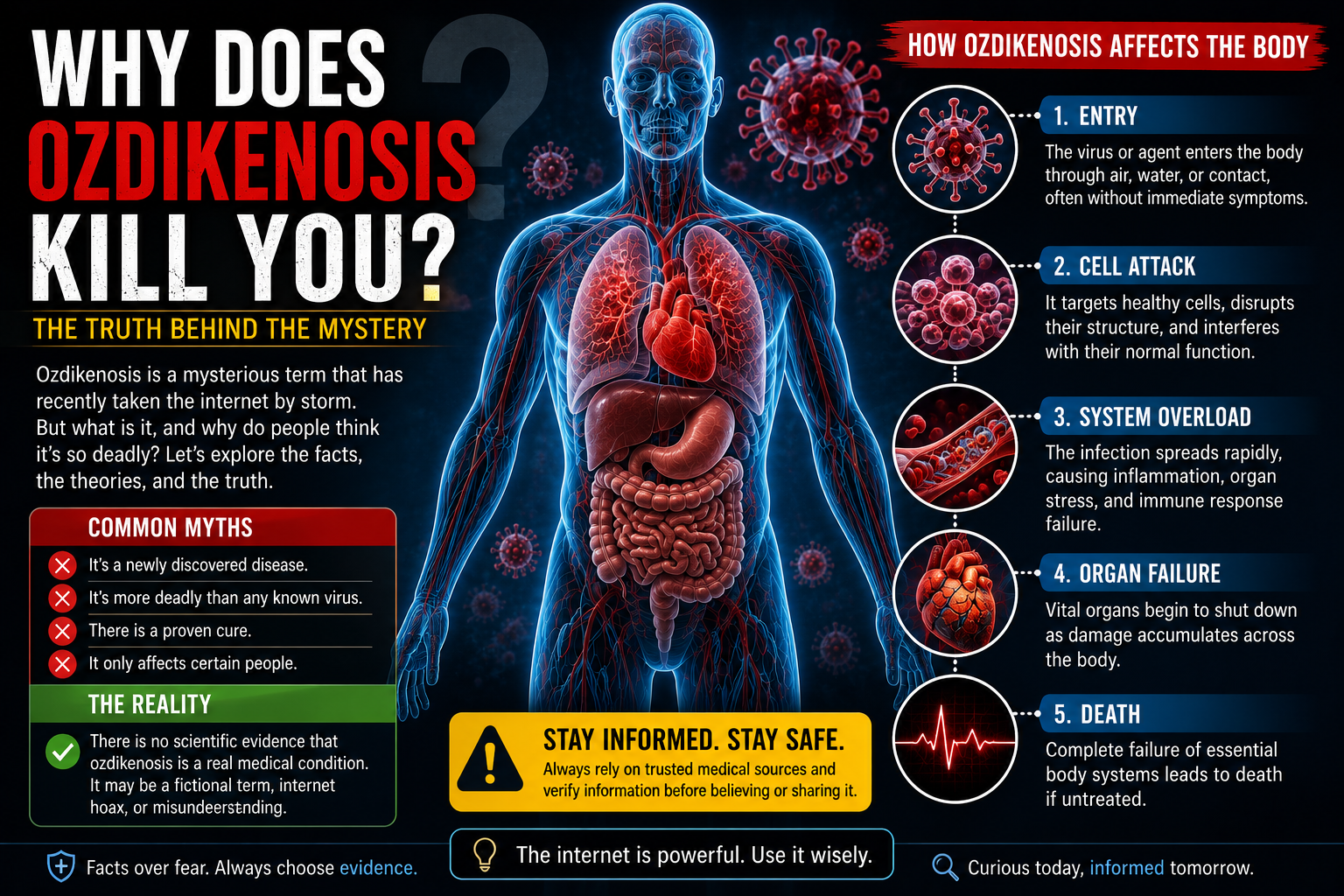
Every year, unusual words and mysterious phrases begin circulating online, often generating thousands of searches from people seeking answers. One such phrase is why does ozdikenosis kill you. At first glance, it appears to reference a dangerous disease or medical condition capable of causing severe harm. The wording itself suggests urgency, which naturally encourages people to investigate further.
However, those who research the term often encounter an unexpected problem. Despite the growing interest surrounding it, there is little to no verified medical information available. This absence of evidence has transformed ozdikenosis into an internet mystery, leaving many people wondering whether it is a real illness, a fictional concept, or something else entirely.
Understanding the story behind why does ozdikenosis kill you requires examining how information spreads online, how people react to unfamiliar medical terms, and why mysterious topics continue to attract attention in the digital age.
The Power of Medical-Sounding Terminology
Language has a significant influence on perception. Certain words immediately sound authoritative because they resemble established scientific terminology.
The phrase why does ozdikenosis kill you is a perfect example. The structure of the word resembles the naming conventions used for genuine medical conditions. Many diseases and disorders include complex suffixes that make them sound technical and specialized.
When people encounter unfamiliar scientific language, they often assume it has a legitimate medical basis. This assumption can create curiosity even before any evidence has been examined.
As a result, terms that sound medical frequently attract more attention than ordinary words.
Why People Search for Answers
The popularity of why does ozdikenosis kill you highlights an important aspect of human behavior: curiosity.
People naturally want answers when they encounter something they do not understand. Health-related topics are especially powerful because they involve issues of safety, survival, and personal well-being.
Even if readers suspect that a term may not be real, they often continue searching because they want certainty. Unanswered questions create psychological discomfort, and research becomes a way to reduce uncertainty.
This desire for clarity explains why mysterious health terms can become surprisingly popular online.
What We Actually Know About Ozdikenosis
One of the most important facts regarding why does ozdikenosis kill you is that ozdikenosis does not currently appear in recognized medical literature.
Legitimate diseases are generally documented through clinical studies, scientific research, and healthcare databases. Physicians, researchers, and public health organizations maintain extensive records of known illnesses and medical conditions.
At present, there is no widely accepted evidence indicating that ozdikenosis is a medically recognized disease.
This absence of documentation does not necessarily explain where the term originated, but it does suggest that claims regarding symptoms, causes, or fatal outcomes should be treated cautiously.
Without scientific evidence, definitive conclusions cannot be supported.
The Possibility of Fictional Origins
One possible explanation for why does ozdikenosis kill you is that the term may have originated from fiction.
Writers frequently invent diseases for novels, films, games, and online stories. Fictional illnesses are often designed to sound realistic, borrowing naming patterns from genuine medical terminology.
This practice helps create immersion and credibility within fictional worlds. However, when such terms spread beyond their original context, confusion can occur.
Readers who encounter the term without understanding its origin may assume it represents a real condition rather than a creative invention.
This has happened many times throughout internet history, particularly with fictional scientific concepts that closely resemble real-world terminology.
Why Mysterious Health Topics Spread So Quickly
Health-related mysteries spread rapidly because they combine two powerful factors: fear and curiosity.
The question why does ozdikenosis kill you immediately raises concerns about danger and mortality. Even without evidence, the wording encourages people to investigate.
Online platforms amplify this effect. Social media posts, discussion forums, videos, and search algorithms often prioritize topics that generate engagement.
The more people click, share, or discuss a phrase, the more visible it becomes. Increased visibility leads to additional curiosity, creating a cycle that can sustain interest for extended periods.
This process explains how obscure topics sometimes become widely discussed despite limited factual support.
The Relationship Between Fear and Information
Fear influences how people process information. When a topic appears threatening, individuals often seek answers quickly.
The phrase why does ozdikenosis kill you naturally triggers concern because it implies severe consequences. People may search for information not because they believe the condition exists, but because they want reassurance.
Psychological research shows that uncertainty can be more uncomfortable than known risks. Even incomplete information may feel preferable to having no explanation at all.
Unfortunately, this urgency can sometimes encourage people to accept unreliable information without proper verification.
That is why careful evaluation remains essential when researching unfamiliar topics.
How Real Diseases Become Recognized
Understanding the scientific process helps place discussions about why does ozdikenosis kill you into context.
Medical conditions are not recognized simply because people discuss them. They become recognized through observation, testing, peer-reviewed research, and documented evidence.
Scientists identify patterns among patients, investigate biological mechanisms, and evaluate treatment outcomes. This process can take years and requires substantial data.
Only after extensive analysis do diseases become officially recognized within medical literature.
Because ozdikenosis lacks this scientific foundation, it cannot currently be classified alongside documented illnesses.
The Role of Misinformation in Online Searches
The internet has made information more accessible than ever before, but it has also increased the spread of misinformation.
Questions such as why does ozdikenosis kill you often attract speculative content because people attempt to provide explanations even when reliable evidence is unavailable.
Once speculation begins circulating, it can be repeated across multiple websites and platforms. Over time, repetition creates the appearance of legitimacy.
Readers may mistakenly interpret widespread discussion as proof of authenticity.
This phenomenon demonstrates why source evaluation is crucial when researching health-related topics.
Why Critical Thinking Matters
Critical thinking is one of the most valuable tools available to modern internet users.
When investigating why does ozdikenosis kill you, readers should ask several questions. Is the information supported by scientific evidence? Does it come from reputable healthcare sources? Can the claims be independently verified?
These questions help distinguish factual information from unsupported speculation.
Critical thinking does not require rejecting every unfamiliar idea. Instead, it encourages people to seek evidence before accepting conclusions.
This approach promotes better understanding and reduces the influence of misinformation.
How Internet Mysteries Capture Public Attention
Internet culture has a long history of embracing mysteries. Unexplained topics encourage discussion, investigation, and community engagement.
Part of the fascination with why does ozdikenosis kill you comes from the uncertainty surrounding it. People enjoy solving puzzles and uncovering hidden information.
When answers are unavailable, speculation often fills the gap. Communities form around discussing theories and exploring possibilities.
While this process can be entertaining, it is important to remember that theories are not equivalent to verified facts.
Understanding this distinction helps maintain a balanced perspective.
The Importance of Reliable Health Information
Reliable health information plays a crucial role in public well-being.
Misinformation can create unnecessary anxiety and lead people to misunderstand genuine medical risks. For this reason, health claims should always be evaluated carefully.
When researching why does ozdikenosis kill you, readers should prioritize information from healthcare organizations, medical professionals, and scientific publications.
These sources are far more reliable than anonymous posts or unsupported claims circulating online.
Developing the habit of verifying information helps individuals make informed decisions and avoid confusion.
Why the Mystery Continues
The mystery surrounding why does ozdikenosis kill you persists because there is no clear, widely accepted explanation for the term.
Its scientific appearance, combined with the lack of available information, creates an ideal environment for curiosity. People continue searching because they want to understand what the term means and whether it represents something important.
Until reliable evidence emerges, ozdikenosis will likely remain an example of how internet mysteries develop and spread.
Its popularity demonstrates the enduring appeal of unanswered questions in the digital era.
Conclusion
The phrase why does ozdikenosis kill you has become a fascinating online mystery despite the absence of verified medical evidence. While the term sounds like the name of a serious disease, current information suggests that it is not recognized within mainstream medical science.
Its growing popularity highlights how curiosity, uncertainty, and internet culture can transform obscure phrases into widely searched topics. The situation also illustrates the importance of evidence-based research and critical thinking when evaluating unfamiliar health claims.
Ultimately, the story of ozdikenosis serves as a reminder that not every scientific-sounding term represents a real medical condition. In an age of rapid information sharing, careful investigation remains the most reliable path to understanding.



Best Tarta de Choclo Near Me: Rated 5 Stars! ⭐
May 29, 2026[…] Comfort foods remain popular because they satisfy both physical and emotional needs. They provide warmth, familiarity, and a sense of connection. […]